
Massive urbanization on a global scale is inescapable. It’s not just a trend, it’s happening. Some research suggests that by 2210 nearly 87 percent of the worlds population will live in a city. This future will undoudtedly highlight both the best and worst of humanity. I don’t harbour visions of the Blade Runner like dystopian future. With meaningful policy, purposeful planning, and the infusion of humanity into technology, I’m hopeful of seeing our collective best.
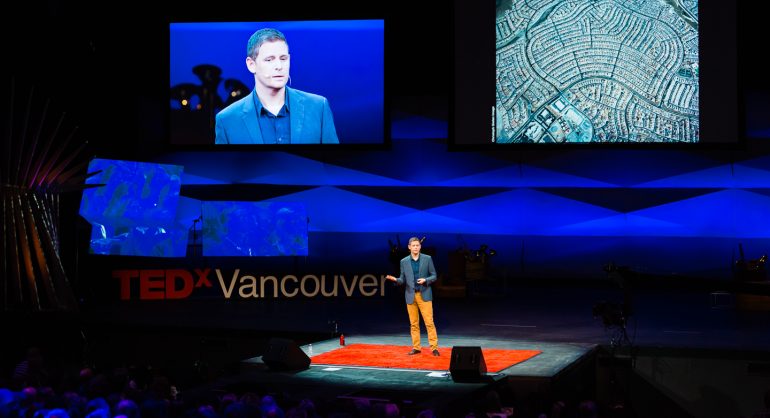
I’ve written about topics like the connected city and urban mobility. It was a significant consideration for the TEDxVancouver team to arrange a conversation with Charles Montgomery. Reading Happy City was a seminal experience. Montgomery works with the BMW Guggenheim Lab, the Museum of Vancouver and other institutions. He creates experiments that challenge us to see our cities—and ourselves—in entirely new ways.
Asked if a city can be happy with technology attempting to make it smarter? “An interesting question” he suggested. “I’d turn it around. I think we need to be asking how is the smarter city going to make us happier? How can it? It may not always.”
Montgomery offered that “there’s a relationship between the use of information and technology in urban systems that may make our lives a little easier. But I’d like to also talk about limitations.”
Mobility’s importance starts the smarter cities conversation. Considering public transit, Montgomery commented that some of the greatest anxiety for transit users involves a sense of uncertainty. “If you don’t know when your bus or train is coming and if you don’t know about making connections, stress levels spike.”
Reducing this stress on shared transit systems isn’t rocket science. This is where information and technology can play a key role. “Just by give people better information make a huge difference,” he said. “When institutions curate more information for customers, doing things a simple as including information or light boards at train and bus stations telling you when the next bus is coming is found to decrease stress.” People feel more in control just having the perception of a shorter wait time.
He talked about the growing number of jurisdictions offering open data. This is allowing app developers the chance work with around transportation systems to give people the information they want in their own pocket. As a Radar user for the Vancouver transit system, he said, “it’s terrific. It shows me where my buses are. It’s not about projected arrival times, I find cognitively that it’s more reassuring to see where the bus is.”
The open data movement can also be empowering for people who just need to get around town. Montgomery sees “it’s powerful for both transit and sharing networks like ZipCar and Car2Go.” He added a unique take on Car2Go, likening it to recycling a pop bottle. Find a car with an app, pick it up, use it, and toss it (leave it curbside). “I think our mobile technologies are essentially enabling these new systems of sharing that are making us more free in cities,” he says.
But he highlighted an important limitation, musing that “we have so far to go.” Recounting a conversation with a leader of the Paris bike sharing program who said, “we know we need to shrink our environmental footprint, and the good news is that it can actually make our lives easier.” He kept returning to this theme of freedom, “what we want is to be free, to move unencumbered through our cities” he said this without mentioning any specific technology or specific mode of movement.
There was a stated desire that more and more Parisians, “want to leave the front door, and want to reach a destination using any mode they please without having to think about it.” Montgomery said further that “he suggested the problem with the old fashioned model of mobility is that you need to own a thing, typically an expensive thing like a car or even a bike. It’s useful for only a few minutes or up to a couple of hours per day, and the rest of the time you have to worry about maintaining it, storing it, and even protecting it.”
The wondrous thing about the Velib bike sharing system in Paris is that it brought a new kind of freedom. A freedom from having to own things, which sounds like Socialism to “us”, but he was talking about valuing experience more that stuff. And guess what, the psychologists and behavioural economists are now telling us that experience is the key to happiness.”
Touching on Aristotle’s notion of Eudaimonia he offered that, “happiness is feeling empowered to reach your full potential. So the question is, how can our cities help us get there? How can they empower us so that we can take on the great challenges of everyday life, and thrive?”
There are current technological limitations relating to shared mobility supply, demand, logistics and fulfillment. Montgomery points out, “in some ways open data and mobile technologies are helping us get there, however I don’t think we can detach ourselves from the realities of the material world. By that I mean, as wondrous as a bike share system or a system like Car2Go is, all you have to do is look at your bike share or car share app to see that at certain times of day there are no vehicles in your neighborhood. They all disappear in the morning, and they all come back at night. So this tells us all the data in the world is not going to fix the issues arising from urban design.”
He talks about intensifying the mix of uses right across the city. “Some people might not like the sounds of this, but if I had more offices, or auto body shops near my house I would have more cars available. And I think the smarter city of the future is necessarily a city of fine grain and mixed uses”
The self-driving car, plus interesting examples of what the cities of Arlington VA, and Vancouver, BC are doing highlight Part II of our conversation.
“It’s impossible to separate the life and design of a city from the attempt to understand happiness, to experience it, and to build it for society.” – Charles Montgomery, Happy City