
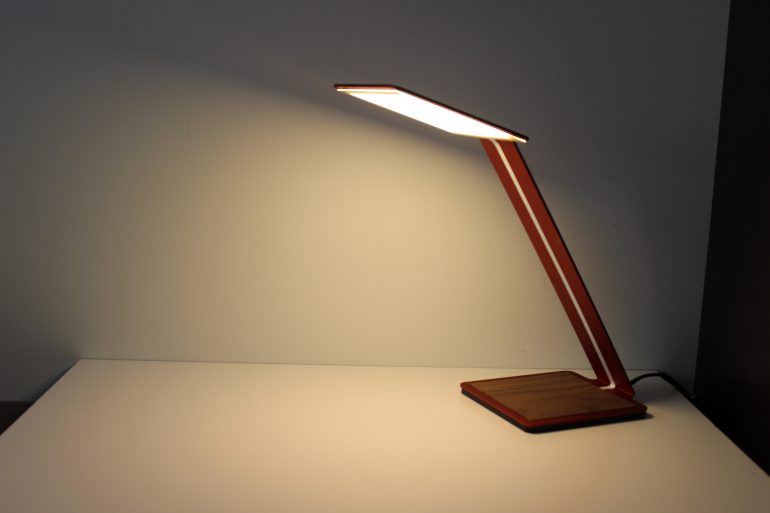
Why settle for LED light pods when your whole ceiling could turn into a light-emitting surface that’s softly, dimly lit?
The light bulbs technology and design space hasn’t significantly changed in decades, even though every engineer knows that your typical incandescent light bulb is a fragile and inefficient kind of miracle. Cofounded by three PhD students from U of T, OTI Lumionics is well on its way to re-invent the lightbulb as we know it. Out with the old, fragile and energy-hungry contraption of blown glass and wire filaments. In with the new OLED technology that makes possible paper-thin, light, flexible, cost-effective and energy-efficient screens of light.
The future of light is warm, high-quality and energy-efficient.
“A few years back, we were just a bunch of grad students working in a field called organic electronics, playing with carbon-based dyes and pigments that are found in clothing and printer ink. We were using organic compounds to build electronics; things that can generate light,” Michael G. Helander, president of OTI Lumionics told BetaKit.
“Our challenge was this thinking in the industry that while organic electronics can be done, it is insanely expensive. We wanted to prove the industry was wrong. When we got interest from big electronics companies that wanted to buy and license our technology, we came up with this crazy idea of just doing it all ourselves. We wanted to design and build all the manufacturing equipment, build devices, do everything and make an actual advanced manufacturing plant here in Ontario that’d be custom and small-volume. And we’re doing it.”
OTI Lumionics came out of the second cohort of startups at Creative Destruction Labs (CDL) based at Rotman School of Management at U of T. Helander credits the support OTI Lumionics received from G7 mentors at the lab, and Lee Lau in particular for transforming the starving, struggling startup into a well-funded, connected company with bright future.
Today, OTI Lumionics is building a new lab to cut down the manufacturing time for their beautiful paper-thin and flexible screens and sheets of light from hours to minutes. “When you go outside, in the middle of the day, where’s the light coming from? It’s coming from everywhere. We’re so used to the little point source of light, a bulb, but why can’t the lampshade be the source of light?” said Helander.
Indeed, why do we still rely on a hundred-years old inefficient incandescent light bulb technology.
The future of light tech is literally down the street at College and University in Toronto. It’s just not evenly distributed yet.